
Current location: ENGLISh > NEWS > Procurement Guide >
Design, Layout, Pipeline Matters, and Operation of Asphalt Insulation Pump
time:2024-11-09 11:35:16 author:特种泵阀 click:292
When arranging pipelines for asphalt insulation pumps, the following precautions should be taken:
1. The pipeline layout should be arranged as straight pipes as possible, minimizing the number of accessories in the pipeline and reducing the length of the pipeline as much as possible. When turning, the bending radius of the elbow should be 3-5 times the diameter of the pipeline, and the angle should be greater than 90 ℃ as much as possible.
2. Choose the diameter of the asphalt insulation pump pipeline. A larger pipeline diameter results in lower liquid flow velocity and lower resistance loss at the same flow rate. However, due to the higher price and smaller pipeline diameter, the resistance loss will sharply increase, leading to an increase in the head and power of the selected pump, as well as higher costs and operating expenses. Therefore, a comprehensive consideration should be given from both technical and economic perspectives.
3. Valves (ball valves or globe valves, etc.) and check valves need to be installed on the discharge side of the pump. Valves are used to adjust the operating point of the pump, and check valves can prevent the pump from reversing and prevent the pump from being hit by water hammer when the liquid flows back. When the liquid flows back, a large reverse pressure will be generated, causing damage to the pump
4. The discharge pipe and its pipe joints should consider the pressure they can withstand.
If the asphalt insulation pump is used with loud noise or large fluctuations in inlet and outlet pressure, the following points should be noted:
1. The bearings and internal components of the asphalt insulation pump are worn out;
2. The suction height of the asphalt insulation pump exceeds the normal regulation;
3. Generating tooth sealing phenomenon;
4. The viscosity ratio of the inhaled medium is high;
5. The discharge pipeline of the asphalt insulation pump has too much resistance and the pipeline is too long;
7. The pipeline for the asphalt insulation pump to suck in liquid is too short;
8. There are blockages in the filter or suction pipe;
9. There is a problem with the rotating part of the asphalt insulation pump;
10. There is air inside the pipeline;
The characteristics of asphalt insulation pump are mainly reflected in the following aspects:
1. Compact structure, easy to use and maintain.
2. It has self-priming properties, so there is no need to inject liquid before each pump start.
3. The lubrication of the gear oil pump is automatically achieved by the conveyed liquid, so there is no need to add lubricating oil during daily operation.
In terms of terminology, a gear oil pump is also known as a positive displacement device, which is like a piston in a cylinder. When one tooth enters the fluid space of another tooth, because the liquid is incompressible, the liquid and the tooth cannot occupy the same space at the same time, so the liquid is mechanically squeezed out. Due to the continuous meshing of the teeth, this phenomenon occurs continuously, thus providing a continuous discharge volume at the inlet and outlet of the pump. The discharge volume is the same for each rotation of the pump. As the drive shaft rotates continuously, the pump also continuously discharges fluid. The flow rate of a pump is directly related to its rotational speed.
Structural characteristics of asphalt insulation pump:
1. The KCB asphalt insulation pump has self-priming properties, so there is no need to inject liquid before each pump start.
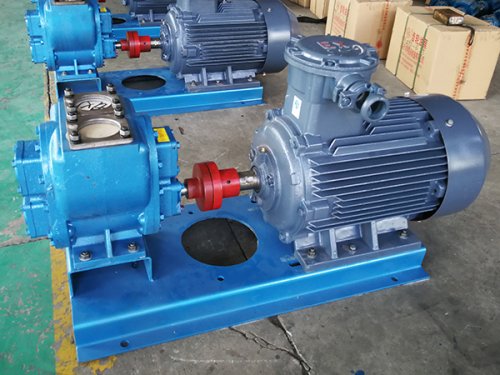
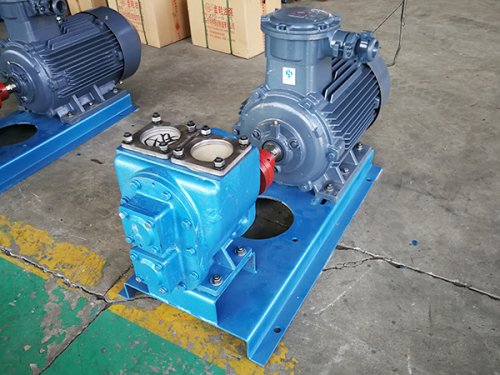
2. The KCB asphalt insulation pump mainly consists of gears, shafts, pump bodies, protective valves, and shaft end seals.
3. There are correct oil discharge and return grooves inside the pump, which reduces the torque force borne by the gears during operation, resulting in low bearing load, minimal wear, and good pump speed.
4. The pump is equipped with a protective valve as overload protection, and the full reflux pressure of the protective valve is 1.5 times the rated discharge pressure of the pump. It can also be adjusted according to actual needs within the allowable discharge pressure range.
5. However, please note that this protective valve cannot be used for long-term operation as a pressure reducing valve. If necessary, it can be installed separately on the pipeline.
6. The gears have good hardness and strength after heat treatment, and are installed together with the shaft in a replaceable shaft sleeve for operation.
7. The lubrication of all parts inside the pump is automatically achieved through the use of the output medium during pump operation.
8. The lubrication of asphalt insulation pump is automatically achieved by the conveyed liquid, so there is no need to add lubricating oil during daily operation.
During the operation of the asphalt insulation pump, a small amount of liquid is used to rinse and cool the annular gap area between the inner magnetic rotor and the isolation sleeve, as well as the friction pair of the sliding bearing. The flow rate of the coolant is usually 2% -3% of the pump flow rate, and the annular gap area between the inner magnetic rotor and the isolation sleeve generates high heat due to eddy currents. When the cooling lubricant is insufficient or the flushing hole is not smooth or blocked, it will cause the medium temperature to be higher than the working temperature of the permanent magnet, gradually causing the inner magnetic rotor to lose magnetism and the magnetic transmission to fail. When the medium is water or water-based liquid, the temperature rise in the annular gap area can be maintained at 3-5 ℃; When the medium is hydrocarbons or oil, the temperature rise in the annular region can be maintained at 5-8 ℃.
Asphalt insulation pump is used to transport liquids with high viscosity, such as lubricating oil and combustion oil. It is not suitable for transporting liquids with low viscosity (such as water and gasoline), and it is not suitable for transporting liquids containing particle impurities (the service life of asphalt insulation pump). It can be used as a lubrication system oil pump and hydraulic system oil pump, and is widely used in engines, steam turbines, centrifugal compressors, machine tools, and other equipment. Another limiting factor, and it is a process variable. Due to these limitations, asphalt insulation pump manufacturers will offer a range of products in different specifications and displacements (the amount discharged per revolution). These pumps will be matched with specific application processes to achieve good system capacity and price.
The two gears of the asphalt insulation pump have different shapes and numbers of teeth. One of them is a ring gear that can float inside the pump body, and the middle one is a driving gear that is eccentric to the pump body. The ring gear has more teeth than the driving gear, and the driving gear drives the ring gear to rotate together, using the change in space between the two teeth to transport liquid. Another type of internal asphalt insulation pump is a ring gear
; There are two more teeth than the driving gear, and a fixed crescent shaped partition is installed between the two gears, which clearly separates the suction and discharge space. Under the same discharge pressure and flow rate, the external dimensions of the inner asphalt insulation pump are smaller than those of the outer asphalt insulation pump.
The impact of flow and head of asphalt insulation pump is as follows:
1. If small, normal, and large flow rates are given in the process, they should be considered as large flow rates.
2. If only normal flow rate is given in the process, allowance should be considered. For high flow low head pumps with NS100, a flow margin of 5% is taken. For low flow high head pumps with NS50, a flow margin of 10% is taken. For pumps with 50 ≤ ns ≤ 100, a flow margin of 5% is also taken. For pumps with poor quality and harsh operating conditions, a flow margin of 10% should be taken.
3. If the basic data only provides weight flow rate, it should be converted to volume flow rate.