
Current location: ENGLISh > NEWS > Company News >
Design considerations and post use repairs for slag oil pumps
time:2024-10-16 11:32:11 author:特种泵阀 click:265
When using a slag oil pump, the following requirements should be noted:
1、 Attention should be paid to the problem of high temperature liquid vaporization in sealing, which may cause dry friction in the mechanical seal.
2、 The high-temperature slag oil pump adopts oil lubrication, and the brand should be matched with the temperature of the bearing box.
3、 As the strength of the material is related to temperature, the strength needs to be recalculated by checking the temperature and pressure gauge of the relevant material. Including flanges, wall thickness, bolts, etc.
4、 The temperature is very high, and the impeller should pay attention to its anti cavitation performance.
5、 Apply intermediate support structure in the structure.
6、 The layout of related cooling pipelines and instruments is beautiful and aesthetically pleasing.
7、 The temperature of the hot screen or cold water chamber should be lowered from the sealing point to the coupling point, as general motors have temperature limitations.
In terms of the types of slag oil pumps, the gears commonly used in slag oil pumps include straight teeth, helical teeth, herringbone teeth, and spiral teeth, with tooth profiles mainly including involute and circular arc types. Usually, small slag oil pumps use involute spur gears, high-temperature slag oil pumps often use variable gears, and melt pumps that transport high viscosity and high-pressure polymer melts often use involute helical gears. The gear and shaft are integrated, and their rigidity and stability are higher than those of the slag oil pump with separate gears and shafts.
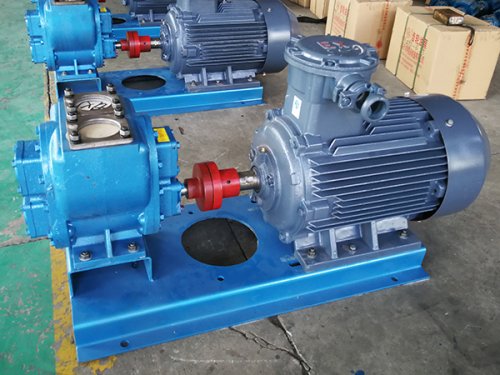
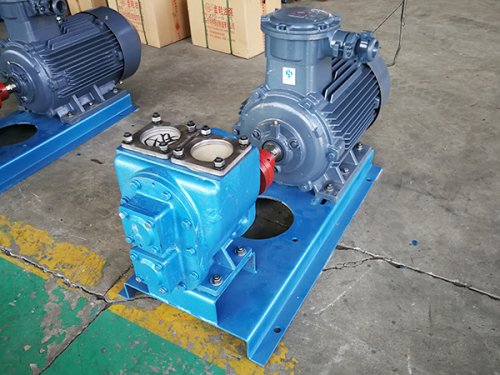
The slag oil pump is mainly composed of gears, shafts, pump bodies, stabilizing valves, and shaft end seals. Gears have high hardness and strength after heat treatment, and are installed together with the shaft in a replaceable shaft sleeve for operation. The lubrication of all parts inside the pump is automatically achieved through the use of the output medium during pump operation. There are good oil discharge and return grooves inside the pump, which means that the gears bear less torque force during operation, resulting in low bearing load and minimal wear, and the pump efficiency is good.
The pump is equipped with a stabilizing valve as overload protection, and the full reflux pressure of the stabilizing valve is 1.5 times the rated discharge pressure of the pump. It can also be adjusted according to actual needs within the allowable discharge pressure range. However, it should be noted that this stabilizing valve cannot be used as a pressure reducing valve for long-term operation. If necessary, it can be installed separately on the pipeline. When viewed from the extended end of the main shaft towards the pump, it rotates clockwise.
The size of the clearance between the end faces of the slag oil pump directly affects the discharge pressure, volumetric efficiency, and flow rate of the slag oil pump. The specific analysis is as follows:
1、 The size of the clearance between the end faces of the slag oil pump has no significant effect on the pulsation of the flow rate of the slag oil pump.
2、 As the speed of the slag oil pump increases, the impact of increasing end face clearance on volumetric efficiency decreases. The area with high velocity in the end face gap leakage is distributed at the meshing of the slag oil pump, indicating that the gap leakage is caused by the pressure difference between the inlet and outlet of the slag oil pump. The high-pressure medium in the outlet area is compressed back into the area through the end face gap, forming end face gap leakage. As the clearance between the end faces of the slag oil pump increases, the leakage velocity between the clearances also increases, resulting in an increase in leakage flow rate and a decrease in pump volumetric efficiency.
3、 At the same rotational speed, the time averaged mass flow rate and volumetric efficiency of the slag oil pump decrease significantly with the increase of the end face clearance of the slag oil pump; Under the same end face clearance, the time averaged mass flow rate and volumetric efficiency of the slag oil pump increase with the increase of the slag oil pump speed.
4、 The high-speed area of leakage flow in the end face gap of the slag oil pump is located at the meshing part, which proves that the pressure difference between the inlet and outlet of the slag oil pump is the main cause of gap leakage. As the end face gap increases, the leakage flow rate between the gaps also increases, resulting in an increase in leakage flow rate and a decrease in the volumetric efficiency of the slag oil pump.
What repairs are needed for the slag oil pump after use? Below, we will provide you with a detailed introduction:
1、 Repair of pump cover: Repair of working surface: If the wear of the working surface of the pump cover is small, manual grinding can be used to remove the wear marks. That is, place a small amount of valve sand on the platform or thick glass plate, and then place the pump cover on top for grinding until the wear marks are removed and the working surface is flat. When the working surface wear of the pump cover exceeds 0.1 millimeters, the method of turning first and then grinding should be adopted for repair.
2、 Repair of worn drive shaft and bushing: After the wear of the drive shaft and bushing of the gear pump, the clearance between them increases, which will inevitably affect the pump oil volume. In this case, the method of repairing the active shaft or bushing can be used to restore its normal fit clearance. If the active shaft has slight wear, simply press out the old bushing and replace it with a standard size bushing, and the clearance can be restored to the allowable range. If the active shaft and bushing are severely worn and the fit clearance exceeds the standard, not only should the bushing be replaced, but the diameter of the active shaft should also be increased by chrome plating or vibration welding, and then ground to the standard size to restore the fit requirements with the bushing.
3、 Repair of Lubricating Oil Pump Shell Cracks: Shell cracks can be repaired by welding with cast 508 nickel copper welding rods. The weld seam must be tight and porous, and the flatness error of the joint surface with the pump cover should not exceed 0.05 millimeters.
4、 Repair of wear on the drive shaft bushing hole and the driven shaft hole: After the wear on the drive shaft bushing hole, the wear marks can be removed by reaming, and then a bushing enlarged to the corresponding size can be used. The wear of the driven shaft hole is also removed by reaming, and then the driven shaft is prepared according to the actual size of the reamed hole.
5、 Repair of valve seat: There are two types of pressure limiting valves: ball valves and plunger valves. After the wear of the spherical valve seat, a steel ball can be placed on the valve seat, and then gently tapped with a metal rod until the ball valve fits tightly with the valve seat. If the valve seat is severely worn, you can first remove the wear marks by reaming, and then use the above method to make it tightly fit. After the plunger valve seat wears out, a small amount of valve sand can be added for grinding until it fits tightly.
6、 Repair of the inner cavity of the pump casing: After the inner cavity of the pump casing wears out, the inner cavity lining method is generally adopted for repair, that is, the inner cavity is enlarged and then fitted with cast iron or steel lining. After embedding, enamel the inner cavity.
According to the laws of proportion and cutting, both methods of changing the pump speed and changing the pump structure (such as cutting the outer diameter of the impeller method) can change the characteristic curve of the gear pump, thereby achieving the goal of adjusting the flow rate (while changing the pressure head). However, for pumps that are already in operation, changing the pump structure is not very convenient, and due to the change in pump structure, the universality of the pump is reduced. Although it is economically convenient to adjust the flow rate at some times, it is rarely used in production. The method of adjusting the flow rate by changing the speed of the slag oil pump can prolong the service life of the pump, save electricity, and reduce the cavitation allowance of the stainless steel gear pump by running at a lower speed, keeping the pump away from the cavitation zone and reducing the possibility of cavitation in the stainless steel gear pump. The disadvantage is that changing the speed of the pump requires changing the speed of the prime mover through frequency conversion technology, which is a complex principle, requires a large investment, and has a small range of flow regulation.