
Current location:ENGLISh > PRODUCT > FCB stainless steel pump >
Stainless steel gear pump
15833379552
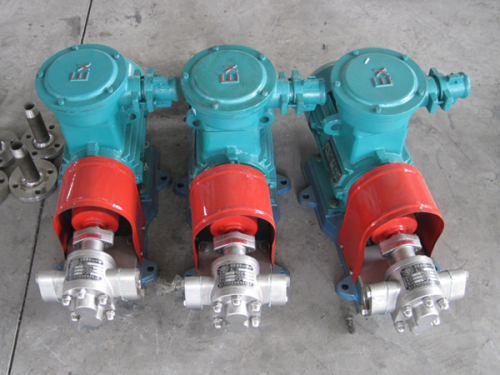
Stainless steel gear pump is a positive displacement gear conveying equipment. The pump body, pump cover, gears and other overcurrent components are made of 304 or 316 stainless steel to resist medium corrosion and avoid material contamination by metal. The products are divided into standard room temperature type and jacket insulation type, which can be matched with motors and variable frequency drive units. They are used for conveying grain, oil and food, chemical, daily chemical, pharmaceutical auxiliary materials, and light oil materials, and can meet the continuous cycle feeding of production lines and intermittent transfer of storage tanks.
The entire unit consists of a stainless steel pump body, front and rear pump covers, hardened stainless steel master and slave gears, transmission shaft, thrust plate, shaft end sealing components, and a common base to form a conveying unit. The gears undergo precision grinding and hardening treatment, meshing, and stable volumetric efficiency; The cavity is equipped with an axial force balance channel to counteract the unidirectional thrust generated by high-pressure operation, reduce the eccentric wear of the thrust plate, and achieve low vibration and noise during long-term continuous operation. For materials that are prone to solidification and viscosity, insulation models can be selected. The pump body integrates an insulation layer and is supplied with steam or heat transfer oil to prevent the medium from cooling and clumping. The moving parts rely on the self lubrication of the conveying medium, without the need for an additional independent lubrication system, simplifying the on-site pipeline layout.
The motor drives the gear to rotate through an elastic coupling, and the volume of the cavity on the side where the gear disengages increases to form negative pressure, causing the medium to enter the tooth groove; The gear carries the medium to rotate to the oil pressure chamber, and the meshing between the teeth squeezes the medium to form pressure and transport it outward. The suction and discharge cycles continue. The flow rate is proportional to the speed, and with the help of a frequency converter, it can achieve flow regulation, stable output pressure, and adapt to working conditions such as furnace pressurization and material transportation.
Most models have built-in reflux valves, which belong to emergency overload protection. When the pipeline is blocked or the valve is closed, the medium flows back to release pressure, protecting the pump body and rear pipeline fittings. Valves cannot be used as voltage stabilizing devices for a long time. It is recommended to connect an external pressure regulating pipeline for constant pressure conditions. The inner wall of the pump body is smooth, and the material is not easy to adhere and accumulate. It is easy to wash and clean after transportation is completed.
The sealing form can be selected with packing seal or hard alloy mechanical seal as needed. Select sealing components for transporting edible oil and syrup; Transport weak acid and alkali, replace solvents with fluororubber seals. The modular structure is easy to maintain, without the need to disassemble the entire machine. The outer pump cover can be removed to replace the sealing components, shortening the downtime of the production line. Conventional media are suitable for temperatures ≤ 120 ℃, and insulation models can be adapted to high-temperature viscous materials.
On the medium adaptation level, the stainless steel gear pump is suitable for conveying liquid without hard sharp particles and with fluidity. The medium kinematic viscosity is 5~1500mm2/s, and it can transport edible oil, syrup, glycerin, essence, lubricating oil, and slightly corrosive chemical auxiliary materials. The 304 model is mostly used for grain and oil, as well as ordinary daily chemical products; The 316 model is suitable for corrosive chemical solutions and raw materials. Not suitable for conveying media containing strong oxidizing acids and large amounts of hard solid particles.
In terms of installation matching, the horizontal base is reserved with standard anchor installation holes, and two types of interfaces, flange and thread, are available for easy connection of soft and hard pipelines. Strictly calibrate the coaxiality when assembling the elastic coupling to reduce vibration wear. Install a pre filter on the suction pipeline to prevent impurities from scratching the gears; The pipeline is equipped with gaskets, causing unstable suction due to air intake. Inject the medium into the pump chamber before starting, and prohibit long-term idling to avoid seal failure due to dry abrasion.
At the level of daily maintenance operations, the whole machine adopts modular design, and the gears, thrust plates, and seals can be disassembled separately. Ordinary tools can be used to complete maintenance. After conveying viscous and easily dry materials, rinse the pump chamber with clean water or a matching solvent circulation to prevent the material from drying and sticking to the gears. Regularly inspect for seal leakage and motor temperature rise, and promptly clean up filter debris. Long term shutdown to drain residual materials from the pump, and take internal rust prevention measures.
During long-term use, we adhere to pre filtration, standardized start stop, and regular cleaning and maintenance, resulting in a low equipment failure rate. The whole machine has a compact structure, with stainless steel material that combines hygiene and durability, occupies a small area, and has moderate operation and maintenance costs.
Overall, stainless steel gear pumps rely on stainless steel overcurrent components and precision gear meshing to achieve stable pressure conveying. They can be equipped with jacket insulation and configuration, and are suitable for conveying food, grain and oil, chemical, and daily chemical media. With a simple structure and easy cleaning and maintenance, they are the mainstream volumetric conveying equipment for material transfer in small and medium-sized production lines.